


What Happens in a UK Independent School Interview? A Guide for 11+ and 13+ Parents
If your child is applying to a UK independent or boarding school at 11+ or 13+, it’s very likely they’ll be invited to an interview. In fact, some schools place significant emphasis on this stage, seeing it as one of the most important parts of their decision-making process.
For many families, the interview can feel like the most unfamiliar part of the admissions journey. What kinds of questions will come up? What are interviewers really looking for?
In this guide, we’ll talk you through what to expect from a typical private school interview – and how you can support your child to approach it with confidence, clarity, and a calm mindset.
Why Do Independent Schools Interview Children?
Independent schools use interviews to understand your child as a whole person — beyond test results or academic performance. Interviews give staff the chance to learn more about a pupil’s interests, character, communication style, and readiness for school life.
Many schools share similar values in their published ethos statements, which often emphasise qualities like curiosity, kindness, resilience, and a love of learning. These statements offer valuable insight into the type of pupil the school is hoping to attract.
Take a look at the ethos statements from some of the leading independent and boarding schools in the UK:
This one is from Harrow:
A school that values courage, honour, humility and fellowship is a school at its best: one deserving of the name ‘Harrow’ and one to which we aspire.
This one is from St Paul’s Boys School in London:
Our three pillars of Scholarship, Opportunity and Character are the foundation of all that we do and we actively focus on five core character traits: Respect, Kindness, Humility, Integrity and Resilience.
This one is from Guildford High School:
Guildford High School is inpsiring, dynamic and fun. We aspire to live life to the full. We are grateful for and seek to make the most of the opportunities we have been given. We thrive on being busy, getting involved and trying new things. We are serious and ambitious about our work and our other activities, but to pursue them with joy, positivty and a sense of fun. We seek to foster in our pupils a livelong love of learning.
This one is from Godolphin and Latymer School in London:
Our am is to provide academic and all round excellence in the education and development of young women by: fostering a love of learning, valuing the individual, widening access, being responsible citizens.
By reading a school’s ethos or values statement, it’s clear that interviews are often used to explore whether a child is a good fit for the school’s culture and community. This is especially true for boarding schools, where staff want to understand not only a child’s academic potential, but also whether they are likely to thrive socially and emotionally—important factors given the extended time spent away from home during the year.
Types of Interviews and What to Expect
Interview formats vary between schools, but most fall into three categories:
- one-to-one interviews
- group interviews
- academic interviews.
At 11+, children often take part in informal conversations with a teacher or head, while at 13+ they may be asked more subject-specific questions or engage in discussion tasks. Group interviews, common at both entry points, might involve collaborative games or discussions designed to assess how children think and interact.
| Interview Type | Common at | What It Involves | What Schools Look For |
|---|---|---|---|
| One-to-One Interview | 11+ and 13+ | A conversation with a teacher, head, or admissions staff. May include personal questions and light academic discussion. | Confidence, communication, curiosity, and self-awareness. |
| Group Interview | Mainly 11+ | Pupils work together in small groups on a task, discussion, or activity. Often observed by staff. | Collaboration, social awareness, leadership, listening. |
| Academic Interview | Mostly 13+ (and scholarship candidates) | Focused on subject knowledge or problem-solving. May include a short comprehension, maths task, or discussion of a topic. | Reasoning, depth of thought, academic curiosity. |
| Online Interview | Used occasionally (especially for overseas applicants) | Conducted via video call. Format varies but often mirrors the one-to-one interview. | Same as above, with added focus on clarity and independence. |
Not all schools use every format – always check with individual schools to understand their admissions process.
What are Schools looking for in the interview?
Many parents worry about whether their child will say the “right” thing in an interview – but the truth is, schools aren’t looking for rehearsed answers. They want to meet the real child behind the application form. The interview is an opportunity to see how your child thinks, listens, communicates, and responds in real time.
The key qualities schools typically look for can be found below:
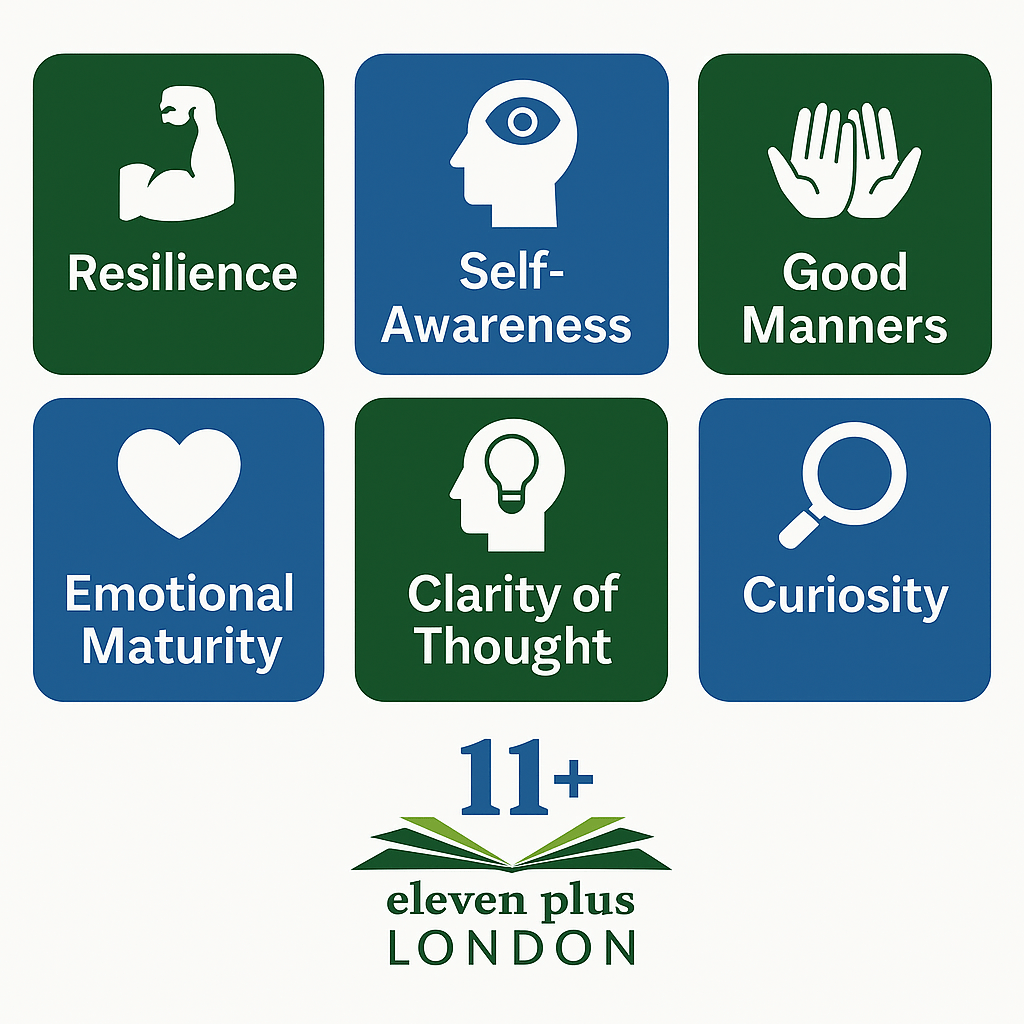
Typically, at younger entry points such as 7+, 8+, 9+ and 10+, and 11+ schools want to see children who are enthusiastic, ready to learn, and socially confident. At more academic 11+ schools, and older entry points such as 12+, 13+ and 16+, schools may also look for intellectual curiousity, critical thinking and leadership potential. This is particularly true for boarding or scholarship places.
Common questions and tasks children might face
Most private school interviews at both 11+ and 13+ involve a combination of personal conversation and light problem-solving tasks. Children may be asked about their interests, recent reading, or how they might respond to everyday situations – for example, “What would you do if someone in your group wasn’t listening?” Some interviews also include gentle academic elements, such as solving a maths puzzle or responding to a short comprehension passage.
The goal isn’t to catch children out, but to understand how they think, speak, and respond. Interviewers are interested in your child’s ability to communicate clearly, reflect on their experiences, and show curiosity – not in rehearsed answers.
Schools often assess these qualities through:
- Open-ended questions – “Tell me about something that challenged you.”
- Scenario-based prompts – “What would you do if your friend was left out?”
- Reflective discussion – “What are you most proud of at school?”
A quiet, thoughtful child can perform just as well as a naturally confident speaker. What matters most is authenticity, engagement, and willingness to try.
🎓 If your child could benefit from gentle interview practice or confidence-building support, we offer one-to-one and small group preparation tailored to their age and target schools.
Click here to find out more about our interview preparation services
How Parents Can Help – Without Over-Coaching
The most effective way to help your child prepare for an interview is to build their confidence in everyday conversation. You don’t need to create formal practice sessions — instead, create regular opportunities to think, talk, and reflect.
Try:
- Discussing books, news stories, or shared experiences — encourage your child to explain what they think and why.
- Asking open-ended questions at the dinner table, such as: “What was the best part of your day?” or “What would you change about school if you could?”
- Practising introductions and light conversation — e.g., “Tell me about your hobbies” or “What makes a good friend?”
- Encouraging reflection — “What are you most proud of this term?” or “What would you do differently next time?”
Avoid scripting responses or correcting every answer — it’s far better for your child to feel comfortable thinking aloud and speaking in their own words. This builds genuine confidence and helps them respond naturally to unexpected questions.
Remember, interviewers aren’t looking for polished performers — they’re looking for thoughtful, curious children who are ready to engage.
If you’d like structured but supportive practice, our mock interview sessions give children the chance to speak confidently and authentically.
Click here to find out more.
What to Expect on the Day
Private school interview days can vary from school to school, but most include a structured combination of activities designed to give staff a well-rounded picture of each child. Typically, families arrive for a welcome talk, followed by a short tour, written assessments, and the interview itself.
👥 Group and One-to-One Interviews
Depending on the school and entry stage (11+ or 13+), children may take part in either a group interview, a one-to-one interview, or sometimes both.
Group interviews often involve a small team activity, discussion, or game. These sessions allow staff to observe how children collaborate, listen, lead, and respond to others.
One-to-one interviews are more traditional and usually take place in a quiet, comfortable setting – such as a study or small meeting room. They may include a mix of personal questions and light academic prompts.
Some schools also run academic interviews, especially at 13+ or for scholarship entry, where pupils are invited to discuss a poem, solve a maths problem, or answer questions related to classroom topics.
⏱️ How Long Does It Last?
The interview itself typically lasts 20 to 40 minutes, though group tasks may be slightly longer. Children are usually interviewed on their own, while parents wait nearby or meet staff separately for a brief conversation or Q&A.
👔 What Should My Child Wear?
Most schools expect children to wear their school uniform if they have one. If not, smart casual clothing (such as plain trousers, a polo shirt, or a tidy jumper) is usually appropriate. There’s no need for formal wear unless specifically requested.
Final Thoughts and Reassurance
The interview day is designed to help both the child and the school decide if it’s a good fit – it’s not something your child is expected to “pass.” Encourage them to treat it as a friendly conversation or a chance to take part in a new experience.
If your child would benefit from gentle interview practice – whether for group activities or individual questions – we offer tailored one-to-one sessions that focus on building confidence, clarity, and calm communication.
Click here to learn more about our interview preparation services
Frequently Asked Questions About Private School Interviews
📏 How long is a one-to-one private school interview at 11+ or 13+?
Interviews usually last between 15 and 30 minutes, though some may be slightly shorter or longer depending on the school.
👨👩👧 Do parents stay for the interview?
Not usually. Most parents wait in a separate area or are invited for a short meeting with staff. Some schools may also interview parents as part of the admissions process.
👔 What should my child wear to a school interview?
If the school hasn’t specified, school uniform is ideal. If they don’t have one, smart but comfortable clothes (e.g. plain shirt, jumper, trousers or skirt) are appropriate.
🎂 What age do private school interviews happen?
- 7+ entry: when children are aged 6-7
- 8+ entry: when children are aged 7-8
- 9+ entry: when children are aged 8-9
- 10+ entry: when children are aged 9-10
- 11+ entry: Usually when children are aged 10–11.
- 13+ entry: Typically when children are aged 12–13.
📚 Do schools ask academic questions during the interview?
Sometimes. At 13+ or for scholarship candidates, children may be asked to discuss a short passage, solve a maths puzzle, or explain a subject-related idea. At 11+, academic questions tend to be lighter or integrated into assessment tasks.
🤔 What if my child is shy or quiet?
That’s absolutely fine. Schools value thoughtfulness and self-awareness just as much as confidence. Practising conversations in a relaxed setting can help your child feel more comfortable speaking with unfamiliar adults.
🧠 What kind of questions are asked in private school interviews?
Questions often focus on your child’s interests, reading, hobbies, experiences, and values. Examples include:
- “Tell me about a book you enjoyed.”
- “What would you do if you saw someone being left out?”
- “What are you most proud of?”
- “How do you handle mistakes?”
📅 When do interview invitations usually arrive?
Most schools send invitations after the entrance exam or application deadline, typically between November and January for 11+ entry, and earlier in the academic year for 13+ pre-tests.
📝 Will my child be interviewed before or after written assessments?
This varies. Some schools interview on the same day as written tests, while others conduct interviews before or after assessment results. Always check the school’s admissions timetable.
🎓 Can I help my child prepare for the interview?
Yes – and in fact, gentle preparation can make a big difference. Encourage everyday conversation, ask open questions, and let your child practise answering naturally. We offer mock interview sessions if you’d like structured support.